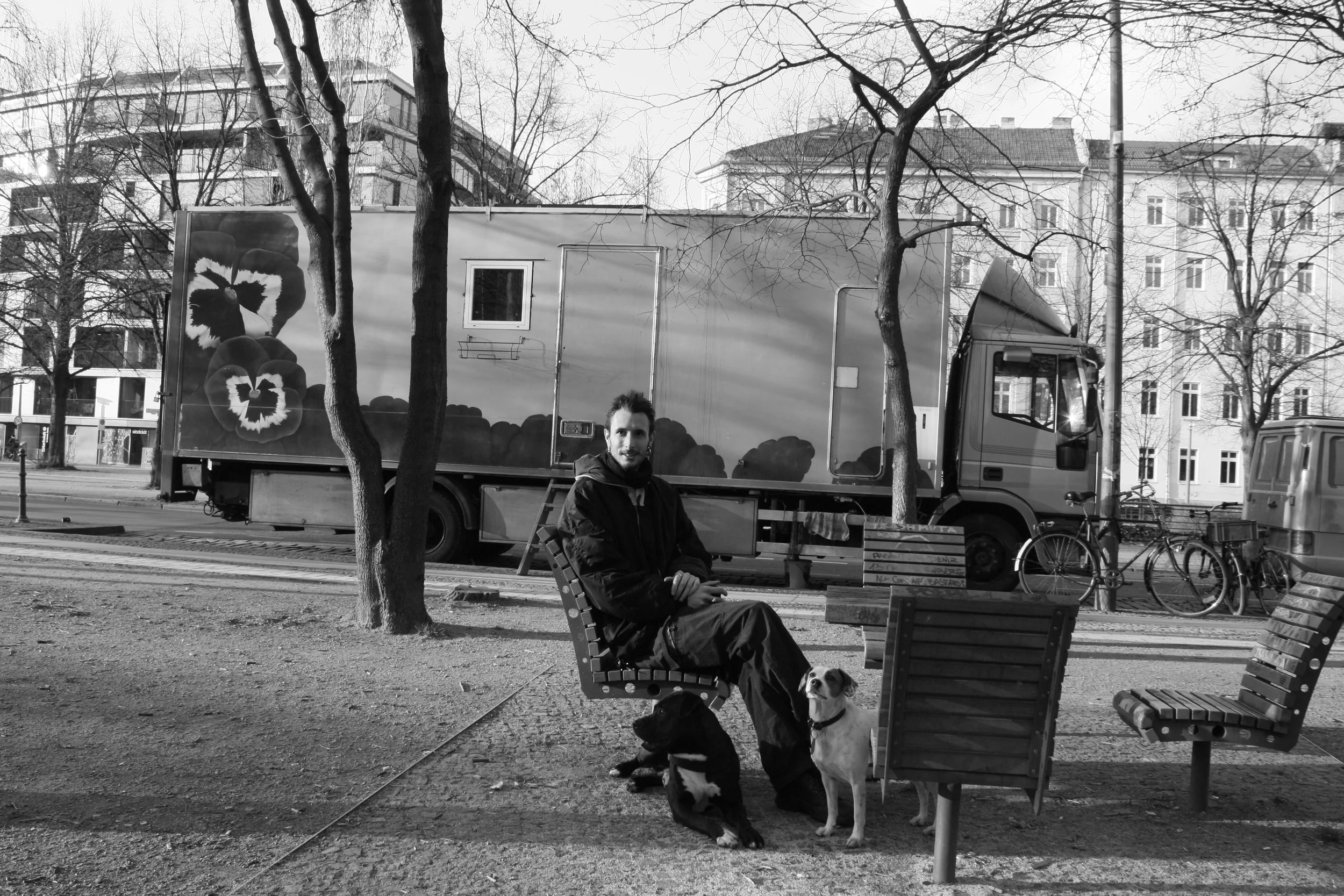
Matteo Cracchi (Carmagnola, 1992) is an Italian sculptor whose research stems from the intersection of sculptural tradition and contemporary underground cultures. Educated at the Primo Liceo Artistico in Torino and the Academy of Fine Arts in Carrara, he simultaneously developed his own imagery through the rave and punk scene, street art, and a long nomadic experience across Europe.
It is primarily in Berlin, amidst Wagenplatz, clubs, and independent spaces, that a visual language based on contrasts takes shape: classical culture and popular imagery, monumentality and precariousness, material and consumption, artisanal discipline and a do-it-yourself attitude. Seemingly distant elements gradually become part of the same exploration.
In 2016, he founded Basura Art Lab in Carrara, a multidisciplinary space born from the redevelopment of an industrial building at the foot of the marble quarries. Here, his daily encounter with stone, processing waste, and recovered materials helps define an approach to sculpture in which the historical and symbolic value of the material is continually brought into tension with contemporary images, objects, and contradictions.
His subsequent experience in France, where he worked on the restoration of the façade of the Musée du Louvre, allowed him to directly explore the techniques of classical and Gothic sculpture and the relationship between sculpture, architecture, and monumental space. Upon returning to Italy, he collaborated with contemporary sculpture studios between Carrara and Pietrasanta, while simultaneously continuing to develop an independent practice.
Cracchi work thus leverages the skills of traditional sculpture to engage with a radically contemporary imagery. Symbols of pop culture, consumer objects, urban iconographies, and references from subcultures are translated through materials and techniques historically associated with monumentality and permanence. From this friction emerge works that interrogate consumption, desire, control, self-destruction, and the contradictions of the very concept of progress.
In 2022, he launched Il Giardino dei Demoni (The Garden of Demons) in the hills of Bologna, a Land Art project conceived as an ever-changing organism. Around two hundred trees, including olive trees and fruit trees, coexist with thirteen sculptures scattered across the landscape. Nature and human intervention thus interact with what the artist calls the "demons of contemporaneity," transforming the landscape itself into part of the work.
In 2026, Teo moved to Brooklyn, New York, where he continued his research, coming into direct contact with American pop culture and the contradictions of the contemporary urban landscape. This move ushered in a new phase in his work, in which the legacy of European sculpture, an underground attitude, and the American imagination converge within a personal sculptural language..
Statement
Artistic nomadism, understood as a cultural and experiential mash-up, is the foundation of a research that explores the undercurrents of contemporary life through its habits, customs, vices, and obsessions, translating them into forms, signs, and matter.
Central to this is the visceral relationship with recycled materials, chosen not only for their physical characteristics but for the memories they carry. These materials retain traces of the contexts they inhabited and of the processes of manufacturing, consumption, and devastation that transformed them into waste. It is precisely from waste—from what is rejected, abandoned, or deemed worthless—that forms and thoughts can reemerge, suggesting new aesthetic possibilities and new perspectives.
Designed to engage with both urban and natural spaces, as well as exhibition spaces, the works often arise from eros, understood as an impulse generating plastic forms and an attempt to translate an inner tension into matter.
In a constant oscillation between raw forms and baroque virtuosity, the research attempts to portray the human being in all its contradictions: at times free, instinctive, and bold; at other times constrained and imprisoned by the dogmas, desires, and stylistic features imposed by contemporaneity.
Marble also enters this process through reclamation. The white Carrara marble used for the sculptures comes primarily from the waste materials of the quarries of the Apuan Alps, a region profoundly transformed by the intensity of extraction.
A shapeless, defective, irregular, or simply unsuitable block thus becomes the starting point for the work. Following its fractures, limits, and natural characteristics, the form is progressively identified in the rough rock. Through method, technique, and feeling, what was destined to be discarded can be transformed into something soft, sensual, and virtuous.
Sculpture thus becomes a process of transformation and redemption of the material: recovering what has been excluded, recognizing its memory, and restoring a new possibility of existence.
TRAINING
2012 Diploma from the First Art High School, Turin (IT)
2019 Bachelor Degree with Honors from the Academy of Fine Arts, Carrara (IT)
2021 Master Degree, Forepabe, from La Châtre (FR)
2022 Internship at the SEM sculpture studio in Pietrasanta (IT)
2022 Master Degree, with Honors, from the Academy of Fine Arts, Carrara (IT)
EXHIBITION
28/04/2018 “Eternity” artistic installation by Maurizio Cattelan, scholarship winner.
01/05/2019 Permanent collective installation “Moloch Death”, at the Mutonia Art Park, Sant’Arcangelo di Romagna (RI).
14/08/2019 Collective installation “Acherontia Atropos” at Pamali Festival, Belluno (IT).
18/10/2019 Group exhibition “Prove d’Artista”, Open One Gallery, Pietrasanta (IT).
28/09/2024 Group exhibition “Equinozio” Villa Piazzo, Pettinengo (IT)
07/06/2025 Group exhibition, Tech Noir Gallery, Rimini (IT)
04/10/2025 Solo exhibition “Sk8 or Die”, Porta Nova 12 Art Gallery, Bologna (IT)
13/10/2025 Winner of the competition, Premio Arte, Golden Plate for Sculpture, Cairo Editore
01/12/ 2025 Publication, CAM, “Gli artisti italiani dal primo novecento a oggi”, numero 61, Editoriale Giorgio Mondadori